Home
Somewhere we know that without silence words lose their meaning, that without listening speaking no longer heals, that without distance closeness cannot cure.
-Henri J. M. Nouwen
Current Issue - Summer 2026
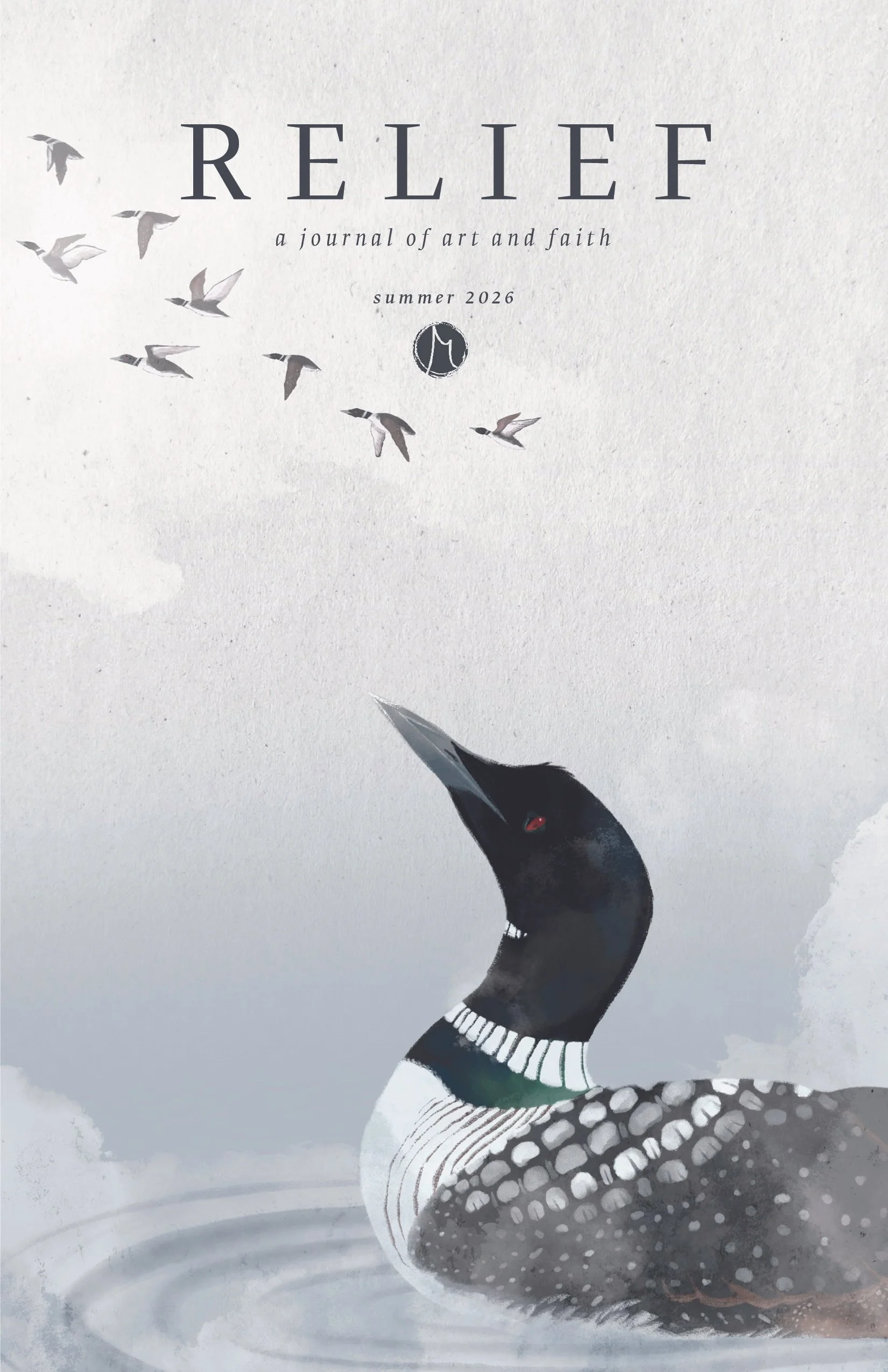
Loon and rippling water at the forefront of Autumn Wright’s cover art invite you into Relief 2026. David J.S. Pickering’s “silence = death” grapples with living in the midst of repeated cycles of injustice. Mika Seifert’s “Bardo” brings us to the threshold that is a pilot’s uncanny island. Elizabeth Bolton’s “Burn It All Down: Notes from an Art History Major” begins with a single flower’s survival from destruction and the wish to understand why. Whether through joyful observation of beauty and connection, unresolved reflection on life’s tangible uncertainties, or determination to simply live life each day, the 2026 issue of Relief asks, in many voices, how we might best carry on.

For over a decade, Relief has helped shape the landscapes of faith and imagination for readers around the world. In our annual print journal, we feature fiction, creative nonfiction, poetry, graphic narrative, and reviews by some of today’s finest literary practitioners, alongside emerging voices. We also publish new reflections on our Substack—meditations by diverse writers pondering our contemporary moment through the rich lenses of art and faith.
From the Blog

Here he was in the form within which he could play and be, where he could flourish in the tension between past and present, now and death, grief and paradise.

Last summer, I did a Reiki session at a yoga retreat twenty miles from Lake Michigan where the woman doing the treatment said you have a real battle between your head and your heart. Afterwards, all I wanted to do was cry, walk in the woods, and stare at Lake Michigan. Reiki felt like an emotional bypass of my brain that went straight to my heart. Poetry, I think, is like that–your heart feels the impact before your brain. I probably think that because of a writer named Jonathan MacGregor.

When I came across Image’s tenth-anniversary issue in a Barnes & Noble in 1999, I’d been failing to navigate my “separate” worlds of faith and imagination in an authentic way. It’s a story I would share with a cadre of lifelong friends I’d meet at Glen Workshops throughout my forties.

What I felt was how deeply the song pierced me, even as I could remember how deeply it pierced me when I was twenty. Like any classic, the song's relevance ages with us.

Abigail Franklin has been telling me for the better part of a year that I need to listen to Preacher’s Kid by Semler. I put it on in the background a few months ago and thought, “Yeah, I like this sound.” But last week I reflected through the entirety of the EP, reading the lyrics along with it and looking up anything that didn’t make sense.

I too find myself living in an age of anxiety. Tolkien worried that the Nazis would drop a bomb on him before his work was done. I “doomscroll” my national, state, and local COVID numbers daily.

My mother loved the sound of the sea. Listening to its rhythm subdued memories that shifted in her heart and soothed pain she carried in the present. There weren’t many books on our shelves at home but there were bits of the sea: sand dollars, bleached white in the sun, starfish and coral with their neon colors and iridescent abalone, mementos from childhood vacations.

These are strange days, the likes of which we’ve never seen. We’ve been overwhelmed by the hot takes, the long reads and think pieces…even the best ones.
Reviews

Ping Zhu’s illustrations, with their distorted perspective, cartoonish drawings, and expansive, colorful stretches of empty space, would grab the attention of a four to nine year old, the age group that both picture books and easy readers target.
Alzanaur’s story celebrates the beauty of strangeness, affirming a truth every child (and adult) instinctively knows, and Ping Zhu’s illustrations make that beauty fully present to the reader in her captivating depictions of children, books, and birds of several kinds.

My favorite poetry texts of 2020 offered places to burrow into comfort without entering echo chambers. They charged through the overgrowth, clearing any number of paths I wished to take—through rage, sorrow, and desire to somewhere resembling peace and affirmation.

Charity Gingerich's debut collection of poetry is a case study in rhythms. The poems are filled to bursting with landscapes and choral hymns, while the poet's own internal rhythms pulse and hum just below the surface. The tension between these interior and exterior worlds, and the struggle to keep their rhythms in sync, form the emotional core of After June.

I have recommended this book to so many people for two reasons: Peterson’s reclamation of evangelical ideas, and her advocacy of women. She unblinkingly tackles evangelical failings: race, sexuality, indigenous rights, and poverty, to name a few.

Somewhere along the way, we have come to believe that a poet’s natural habitat is a coffee shop where—maintained and caffeinated by well-trained baristas—he can brood in private and pace his mind in tiny circles without breaking free to harm the general populace. So when Mr. Webster came to town, it seemed only fitting—however stereotypical—to meet him where he might feel most at home and discuss his latest poem: “The Solemn Sea.”

Wolfe elicits the praise of other novelists because he wields the powers they prize most, both as readers and fellow craftspeople: subtlety, complexity, a virtuosic handling of language, all married to a control that focuses the laser of his genius into the cutting of something greater than the sum of its parts. I suspect writers of speculative fiction love him with a special love because he is both the instantiation and justification of their much-maligned subculture.

The Book of Kells, winner of Poetry by the Sea’s 2018 Best Book Award, by acclaimed poet Barbara Crooker is her most luminous, multi-layered collection yet. Granted two writing fellowships at the Tyrone Guthrie Centre in Annaghmarkerrig, Ireland, Crooker spent time there researching, observing, and writing about the ancient, illuminated manuscript.
His guidance was gone. The number of emails we had sent each other was now fixed.